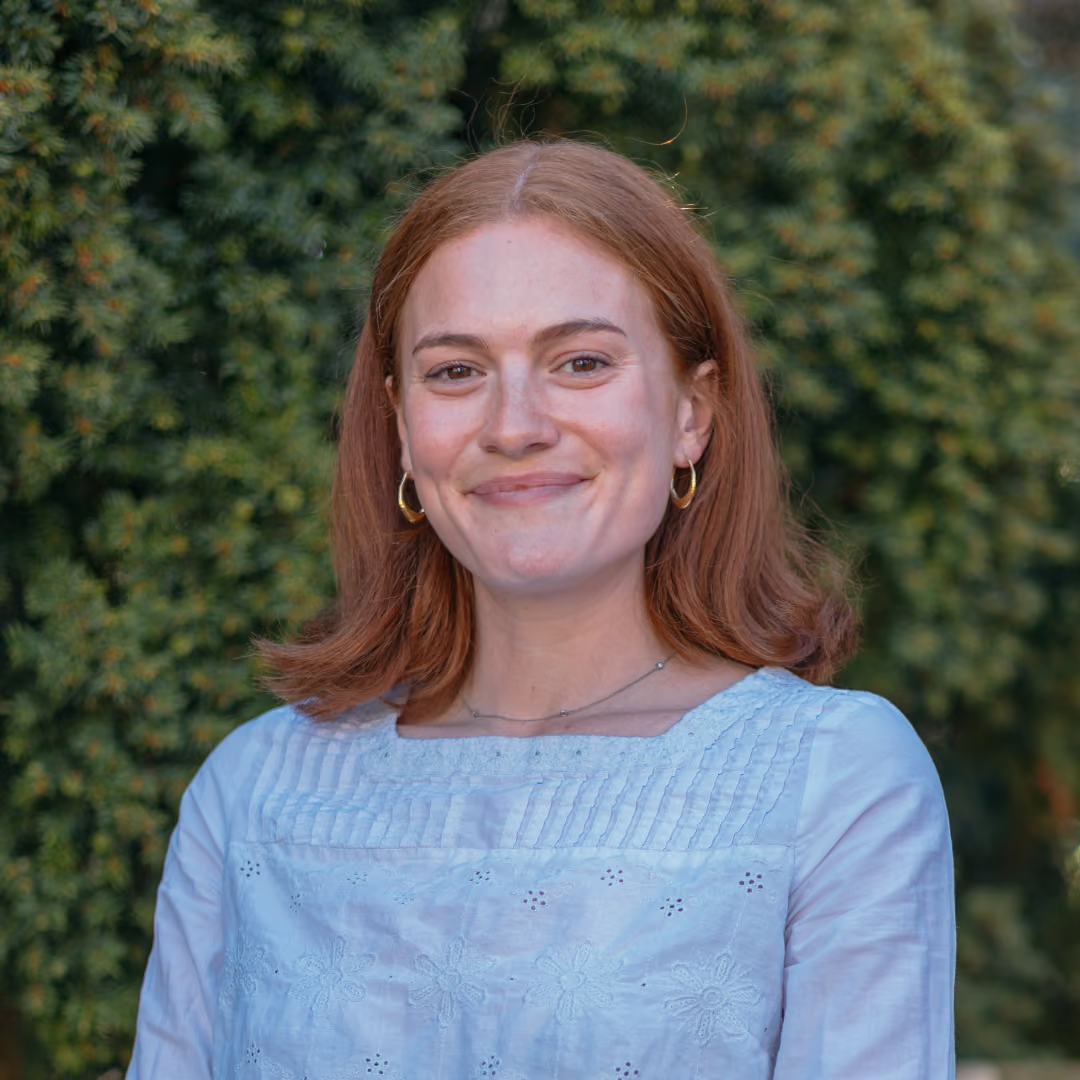
When she was growing up, Bev Flanagan wanted to be a policewoman. Her accountancy career would come later, after she stumbled into it almost by accident on a business and finance course at college, and never looked back. Over three decades in the profession, she's often been the only woman in the room, and she built her own practice through methods that were, at the time, distinctly unconventional. When she sold that business in 2022, she decided to dedicate her time to helping other business owners improve their outcomes. We sat down with her to talk all things accounting, technology, social media and building a community.
P.S. 4 days left to enter into our tea party prize draw for £500 in Virgin Experience Vouchers, plus a year's supply of tea
Getting into accounting
Bev's path into the profession started almost by chance. "I did a business and finance BTEC National Diploma. Part of that module was accounting, and when my trial balance balanced, I stood up and went 'yay', and that’s when I thought, oh, I quite like this accountancy stuff."
From there she studied accountancy and statistics at university, working through the AAT, where she remains today.
She worked her way up from an accounts assistant to become the financial controller for four of the Daily Mail's companies. When the group centralised accounting into a shared service centre in Leicester, she and her colleagues were made redundant. "I remember saying to my boss at the time…I think I'm going to start my own accounting practice. I've got nothing to lose." Seventeen years later, she’d go on to sell that business.
"No one really teaches you how to start a business. You literally wear all the hats when you first start, because you have to, and you have to sort of wing it and work it out as you go along."
The changing accounting world
Across her career in the space, two changes stand out for Bev above everything else: Technology, and representation.
"When I first started, I was literally the only woman in the boardroom. I know a lot of other people in the industry who've been in it a long time like me, and they say exactly the same. So that's changed for the better, which is brilliant."
Technology has reshaped what the job of an accountant looks like entirely: "We now can be more advisory to our clients, because we've got the tech there to do the day-to-day, the repetitive tasks that once upon a time I had to write by hand."
Bev sees one constant (for better and worse) "Accountants and bookkeepers are genuinely nice people, and they care for business owners. But on the flipside, we tend to give things away for free, and undervalue our time and expertise."
That instinct also shapes how deep client relationships run. "Sometimes clients become friends. I'd say I've been like a marriage guidance counsellor in the past." It's why she thinks it pays to build a network of complementary experts, insolvency practitioners, HR specialists, and so on, "because clients will naturally come to us first, and we can't offer services we're not qualified to do ourselves."
Where AI fits in
Bev is unequivocal that AI is a tool, not a replacement. "Ask AI and it might say you don't need an accountant or bookkeeper. But there's nothing like human interaction to be able to speak with clients and understand their intentions for the future so we can help them."
Where it does earn its place is in repetitive work. "It's a massive helping hand for the mundane, repetitive tasks. It's helping us to be more efficient, so we then free up more time to spend with clients." And that time is what keeps clients in the first place: "Nine times out of ten, the reason clients leave accountants is because they feel they don't have time for them. Clients aren't as price-sensitive as people think. They want to pay for that extra support, and if they don't know you can offer it, they'll go elsewhere."
That philosophy shaped her switch to Adfin. "I'm always open to looking at software if it makes my life and my client's life better, but I'm not into the shiny software syndrome. I always like to do the research on it, which I did." The migration itself won her over: "The team moved all my clients to Adfin, and I didn't have to do anything. It was all done for me, which I didn't believe would happen so smoothly, but it did, and it was brilliant. I don't have to worry about debtors, because I know it's just going to get collected."
Building a following
Bev's profile in the industry came from a deliberate decision to not look like everyone else. "I used to go to networking events in a high-vis vest just to be different.” This translated into how she built an audience online, “I think I got a bit of a following because people were interested. We're not the stereotypical boring, grey-suited accountants."
Selling her practice in 2022 became an unexpected catalyst. "I just got inundated with messages, and I started to get people saying, can you help me with my business." That's the seed her academy and community grew from, now a 12-month programme alongside ongoing online and in-person events.
She's a believer in staying visible, however the discovery happens: "People don't know what they don't know, and if you're not telling people what you do, they can't find you." One of her clients recently landed her first client through ChatGPT, after someone searched "who's the friendliest bookkeeper in the UK.”
The advice she gives most
Asked what she repeats most often to accountants who come to her for help, Bev doesn't hesitate: mindset. "If you've got a negative, fixed mindset, it doesn't matter how many clients you've got or how big your social media following is, you won't succeed in the goal you really want."
"Mindset is massive, because everything else flows from it, pricing especially. If you haven't got a positive mindset, you'll undercharge every single time, and you'll work with the wrong clients every single time."