We recently sat down with Oliver Tromp, who leads Actionstep in the UK, alongside our CEO Tom Pope and Chief of Staff Lucy Grant, to talk about why law firms still wait months to get paid and how AI agents can help. Here are the key insights from the conversation.
In short
- Lockup, the time between doing the work and getting paid for it, has barely moved for UK firms in a decade, despite almost every firm using billing software.
- Chasing tends to fall between fee earners, accounts teams and partners, so it often happens late or not at all.
- Automated chasing is far more workable now that partners can approve messages, choose who sends them and set different rules for each practice area.
- Accountancy moved from annual invoicing to direct debit at engagement over about 15 years. Some legal work could follow.
Why lockup has stayed so high
UK law firms wait a median of 134 days between doing the work and getting paid, according to Law Society figures Oliver shared. That's around four and a half months, and it's barely changed in a decade, even though most firms now use billing software.
What is lockup?
Lockup is the time between doing chargeable work and receiving payment for it. It's made up of WIP days, for work done but not yet billed, and debtor days, for invoices sent but not yet paid.
The main reason is that chasing doesn't clearly belong to anyone. Fee earners would rather spend their time on client work, and they're the most expensive people in the firm to have sending reminders. Accounts teams have the time but often don't know the client or the matter, so it's hard to judge the timing or the tone. And partners are wary of anything that might strain a relationship they've spent years building.
"It's very good at producing the bill, but producing the bill was never the hard part. The hard part is everything that comes after."
Oliver Tromp, Actionstep
Until recently, there wasn't a good way round this. Chasing consistently meant hiring people to do it, which adds back-office cost and hands client conversations to someone outside the relationship. Most chasing software sent the same template emails on a fixed schedule, with no way for a partner to see or approve them, so it's no surprise it never caught on in legal.
Getting paid promptly is part of good client service
Picture a conveyancing job finished in September, invoiced the following March and still being chased in August. That happened to Tom. He always intended to pay, but a PDF with bank details turning up every few months isn't a good experience. Most clients would rather get the invoice when the work is done, with a link to pay in a couple of clicks.
Accountancy shows how far this can go. Fifteen years ago, accountants invoiced much like law firms do now, and collecting fees up front would have seemed strange. Today, signing a direct debit mandate with your letter of engagement is normal. That won't suit every legal client, but for some types of work it could bring WIP close to zero.
What is a direct debit mandate?
It's a one-off authorisation a client gives you to collect payments from their bank account when they're due. The client is told before each payment is taken and is covered by the Direct Debit Guarantee.
Partners can stay in control of every message
Automated chasing only works in legal if partners trust it. You can require a partner to approve every message before it goes out, and choose whether reminders come from your own email address, from Adfin or a mix of the two.
Some firms have the partner send the first message and a payments address handle the follow-ups, which keeps a little distance between the relationship and the reminder. Others want every message to come from a named person, because clients tend to reply to people.
Disputes are simple to handle. You can switch a client to a setup with chasing turned off until it's resolved, or let them raise a query from the payment page, which pauses the reminders and creates a task for your team.
Different clients need different rules
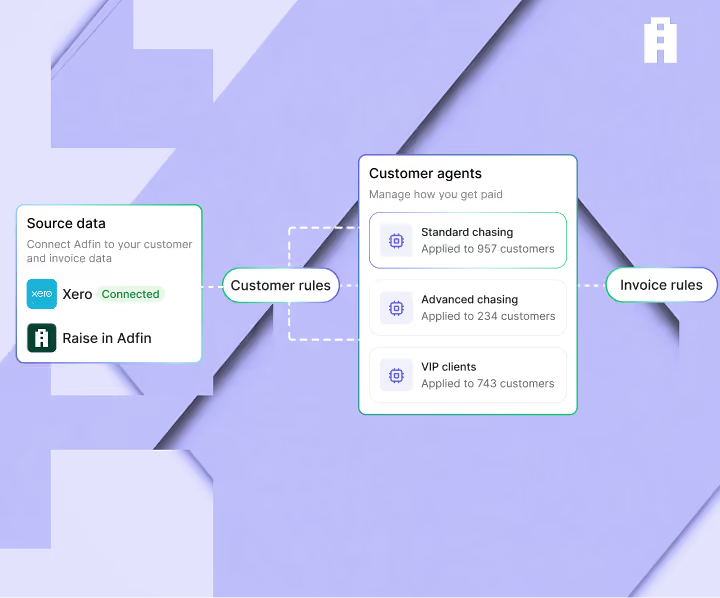
A firm with commercial and family teams has two very different sets of clients, so each needs its own setup. In Adfin, that's a collection agent. It covers how the client pays, how and when they're contacted, and which tools are switched on.
What is a collection agent?
It's Adfin's name for a set of rules applied to a group of clients: how they pay, how and when they're reminded, and which tools, such as late fees, are switched on.
Reminders learn from each client's payment history. If someone usually pays on a Wednesday, or ignores email but answers a text, the timing and channel adjust. Each message carries the client's own invoice details, so it reads like something your accounts team wrote.
Late fees are a good example of a rule that differs by team. Since 1998, businesses have been able to charge statutory interest on late business-to-business invoices, even if their terms don't mention it. Few do, because calculating it by hand is a hassle. A commercial team might apply it automatically, while a family team, whose clients are mostly individuals, would leave it off.
What is statutory late payment interest?
Under the Late Payment of Commercial Debts (Interest) Act 1998, a business can charge interest on a late invoice to another business at 8% above the Bank of England base rate, plus a fixed sum of £40, £70 or £100 depending on the invoice value. It doesn't apply to invoices sent to individuals.
Measuring progress
Lockup is made up of WIP and debtor days, and it helps to track them separately because they need different fixes. Debtor days come down with better collection. WIP depends more on how and when partners bill.
The share of invoices paid late is another useful number, because it's easy to calculate and easy to explain. Tom cited FreeAgent data showing 64% of invoices across 200,000 UK businesses were paid late, compared with 9% across Adfin customers.
A few things you could try
- Find your lockup figure and split it into WIP days and debtor days.
- Check what share of last quarter's invoices were paid late.
- Group your clients the way you'd naturally describe them, such as commercial, private client and family.
- Decide how each group should be chased, and who sends the first reminder.
- Pick one type of matter where a direct debit at engagement could work, and try it with new clients.
Common questions
What is lockup in a law firm?
Lockup is the time between doing chargeable work and being paid for it. It combines WIP days, for work done but not yet billed, and debtor days, for invoices sent but not yet paid. Law Society figures put the median for UK firms at 134 days.
Can law firms charge interest on late invoices?
Yes, if the client is a business. Under the Late Payment of Commercial Debts (Interest) Act 1998, you can claim 8% above the Bank of England base rate on late business-to-business invoices, plus a fixed compensation sum. It doesn't apply to individuals, so it's unlikely to cover most family or private client work.
Will automated chasing damage client relationships?
It can if every client gets the same template on the same schedule. The risk drops when partners can approve messages, you choose the sender, and each reminder includes the client's own invoice details.
What happens to reminders when a client disputes a bill?
They pause. You can switch the client to a collection agent with chasing turned off, or the client can raise a query from the payment page.
How long does setup take?
Some firms go live the same day. Most take a little longer, mapping their current process with a customer success contact first.